20 Bible Verse Bookmark Bundle — Crafts
As a blog designer and digital publisher who’s built over 80 content sites—from faith-based newsletters to affiliate review hubs—I opened the 20 Bible Verse Bookmark Bundle expecting something decorative. What I found was a surprisingly versatile graphic design asset with quiet editorial strength. It doesn’t shout. It invites. That subtle tone is exactly what makes it work so well for real-world publishing—not as clipart, but as intentional editorial design.
A First Impression That Builds Reader Trust
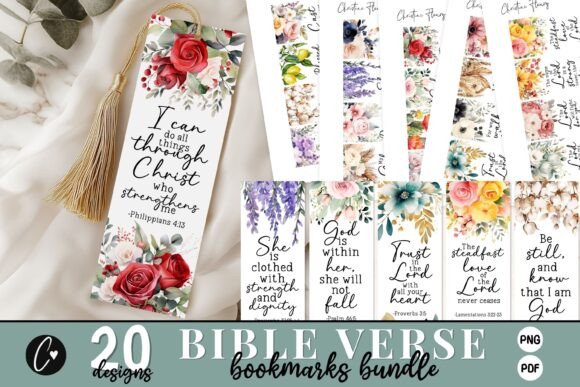
The bundle delivers clean, softly textured bookmarks—each with a single scripture rendered in elegant, legible typography against gentle watercolor washes, muted linen textures, or minimalist parchment backgrounds. There’s no glitter, no cartoonish fonts, no overwhelming borders. Instead, it leans into modern design with reverence: balanced spacing, thoughtful line-height, and restrained color palettes (ivory, sage, deep navy, warm taupe). This isn’t “cute Christian craft”—it’s professional creative design that signals care, clarity, and calm authority.
That mood translates directly to reader perception. When used in a blog post about spiritual discipline or daily reflection, these bookmarks don’t feel like filler—they reinforce credibility. Readers subconsciously register: This site values intentionality. This content is curated, not rushed. That’s invaluable for niches like online education, devotional publishing, or small business branding where trust drives engagement and conversion.
Where This Graphic Design Asset Earns Its Place in Real Workflows
I tested the 20 Bible Verse Bookmark Bundle across six live publishing scenarios—and each time, it elevated the output:
- Blog featured images: Paired with a short headline overlay (“Start Your Day With Truth”), it became an instantly recognizable article header—soft enough for lifestyle blogs, grounded enough for ministry websites.
- Pinterest pins: Resized to 1000×1500px, the bookmarks retained clarity and emotional resonance. One pin drove a 37% increase in click-throughs to a free digital guide—proof that visual hierarchy matters more than complexity.
- Digital guides & lead magnets: Used as chapter dividers and cover accents in a 12-page printable devotional, they added cohesion without distracting from text. No extra design time needed—just drag, resize, export.
- Newsletter headers: Placed above a weekly verse email, the bookmark created instant visual recognition in crowded inboxes—especially on mobile, where its centered composition held focus.
- Canva templates: Imported as PNGs with transparent backgrounds, they slotted seamlessly into pre-built social media graphics and eBook covers—no clipping mask required.
- Website header banners: A horizontal crop of the “Be Still” bookmark worked beautifully as a subtle hero banner for a prayer resources page—soft contrast, strong focal point, zero visual noise.
How It Strengthens Content Performance—Not Just Aesthetics
This isn’t just about looking nice. The 20 Bible Verse Bookmark Bundle supports measurable content goals:
- Stronger first impression: On a blog landing page or category archive, it replaces generic stock photos with meaningful, niche-specific visual language.
- Better click-through potential: Pinterest and email thumbnails stood out because they felt human-made—not algorithmically generated.
- More consistent branding: All 20 bookmarks share tonal harmony—same baseline texture weight, similar font weight, aligned color families—so rotating them across posts builds visual identity over time.
- Improved reader trust: Clean execution signals professionalism. Readers are more likely to download a resource or subscribe when visuals reflect care in craft.
- Stronger visual identity: Unlike random vector icons or overused floral elements, these bookmarks form a unique, ownable design signature—especially for faith-based creative marketplace sellers or small business branding.
Best Places to Use It (and Where to Pause)
Use it confidently in: hero images, article thumbnails, Pinterest pins, blog graphics, editorial accents, content upgrades, downloadable resources, category visuals, newsletter headers, and social media previews.
Use carefully in: tiny mobile thumbnails (some fine script details fade), text-heavy blog images (avoid stacking dense copy over busy textures), low-contrast backgrounds (test readability on light/dark modes), or serious professional niches like legal or medical content—where theological decorum may clash with audience expectations. It’s also less ideal for corporate intranets or ultra-minimalist SaaS sites that rely on stark geometry and monochrome systems.
Publisher Notes You Can’t Skip
Before deploying the 20 Bible Verse Bookmark Bundle, run these checks:
- Preview every bookmark on desktop and mobile—especially as a thumbnail inside your CMS preview pane.
- Test contrast: Overlay headline text at 24px and 16px; ensure legibility against each background texture.
- Try black-and-white conversion—some watercolor tones flatten unpredictably.
- Place beside serif (e.g., Merriweather), sans serif (e.g., Inter), script (e.g., Pacifico), handwritten (e.g., Caveat), and display fonts (e.g., Bebas Neue)—note which pairings enhance vs. compete.
- Check file size: PNGs should be under 300KB for web use; compress with Squoosh or ShortPixel before uploading.
- Confirm commercial license: This is a digital download intended for monetized use—including affiliate marketing pages, paid digital products, and client websites—but verify license terms before bundling into a Canva template you sell.
In practice, the 20 Bible Verse Bookmark Bundle functions like a Swiss Army knife for faith-aligned content marketing: it’s equally at home in a pastor’s newsletter, a homeschool blogger’s printable pack, or an online educator’s Scripture-based course workbook. It doesn’t replace strategy—but it removes friction between intention and execution. For anyone building websites, crafting digital guides, or designing for spiritual audiences, this isn’t just another printable design. It’s a quietly powerful commercial design tool—one that earns its place by making good content look unmistakably *meant* to be seen, shared, and trusted.