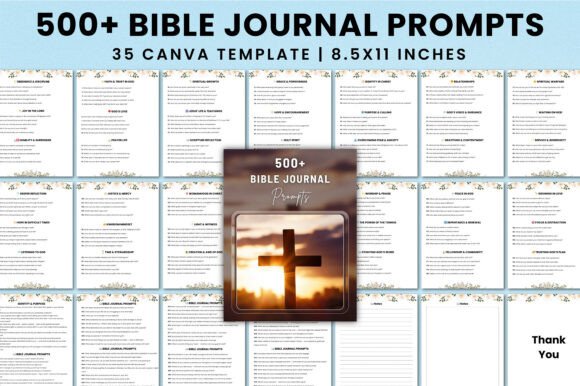
500 BIBLE JOURNAL Prompts for Canva by Kdp Interiors
As a brand designer who’s developed visual systems for over 40 local businesses—from artisanal candle studios and farmhouse-style bakeries to botanical skincare lines and children’s book publishers—I opened 500 BIBLE JOURNAL Prompts for Canva expecting devotional utility. What I found instead was a surprisingly versatile graphic design asset with quiet, grounded elegance—soft watercolor textures, gentle line work, and typographic warmth that leans into reverence without rigidity. It feels handmade, intentional, and quietly confident—not preachy or overly ornate, but deeply human. For a small business owner building authentic local appeal, this isn’t just clipart; it’s a mood board in vector form.
A Real Project Lens: Branding “Grace & Grain,” a Faith-Inspired Bakery
Last month, I used 500 BIBLE JOURNAL Prompts for Canva while developing the full brand identity for Grace & Grain—a women-led bakery in Nashville serving scripture-themed sourdough loaves, communion bread kits, and seasonal baked goods. Their customers value intentionality, craftsmanship, and spiritual resonance—not religiosity as marketing. The prompts’ gentle floral motifs, subtle cross silhouettes, and hand-lettered script variants became foundational decorative elements across packaging design, product labels, and social media graphics. They helped us avoid cliché while reinforcing warmth, care, and quiet conviction—core traits of their local business voice.
Where This Asset Strengthens Local Business Presentation
500 BIBLE JOURNAL Prompts for Canva supports stronger first impressions by adding emotional texture to otherwise functional surfaces—like a kraft paper bag stamped with a minimalist olive branch motif, or a thank-you card tucked inside a soap bundle. It improves product recognition when used consistently: a recurring vine border on hang tags, product mockups, and Instagram story highlights creates visual continuity no algorithm can replicate. Clearer visual hierarchy emerges when prompts serve as elegant dividers between ingredient lists and brand storytelling on food labels. And yes—it builds customer trust. When your packaging feels thoughtfully composed—not templated or rushed—it signals respect for both your craft and your customer’s attention.
Smart Applications Across Real Small Business Touchpoints
This graphic design asset shines where authenticity meets practicality:
- Product labels: Use floral or scripture-inspired borders to frame nutrition facts or origin stories—especially effective for honey jars, tea tins, or bath salt pouches.
- Packaging accents: Apply subtle watermark-style prompts behind handwritten copy on gift boxes or mailer wraps for boutique brands.
- Hero graphics: Layer prompts over high-res product photos for website banners or Facebook cover images—ideal for seasonal campaigns (Advent, Lent, Easter).
- Printable inserts: Include journal prompts as branded extras inside subscription boxes or retail kits—adds perceived value without inventory cost.
- Social media graphics: Pair prompts with short affirmations or verses for consistent, scroll-stopping content—no need for custom illustration each time.
Where to Proceed With Intention
While versatile, 500 BIBLE JOURNAL Prompts for Canva isn’t universal. Avoid using dense or highly detailed prompts on very small labels—legibility suffers at under 0.75" height. Steer clear in crowded packaging layouts where decorative elements compete with critical info like allergen statements or net weight. It doesn’t suit luxury minimalist brands relying on stark negative space, nor formal corporate branding where tonal alignment is non-negotiable. And never place delicate line art over low-contrast backgrounds (e.g., light gray text on cream)—always test print output and screen readability.
Practical Designer Notes You’ll Actually Use
Before committing to 500 BIBLE JOURNAL Prompts for Canva in client work or your own handmade business:
- Test it on real packaging mockups—especially curved surfaces like mason jars or tapered candle sleeves.
- Check black-and-white usage: many prompts rely on subtle grayscale gradients that vanish when converted to monotone.
- Preview on small labels—even if the PNG looks crisp at 100%, zoom to actual size before finalizing.
- Test alongside your brand colors: does the watercolor wash mute your primary hue? Does the script font clash with your display type?
- Compare against competitor packaging—does it elevate your shelf appeal or blend in?
- Review SVG editability: some prompts are grouped layers—ungroup to adjust stroke weight or recolor individual elements.
- Test typography pairings: try prompts beside serif (e.g., Playfair Display), sans serif (Montserrat), script (Pacifico), and handwritten fonts (Caveat) to see which reinforces—not competes with—your voice.
- Confirm commercial licensing: 500 BIBLE JOURNAL Prompts for Canva includes a commercial license, but always verify scope—especially for physical product sales and resale items.
More Than a Digital Product—A Brand Consistency Tool
In today’s saturated creative marketplace, small business branding isn’t about one perfect logo—it’s about cohesive, repeatable moments of recognition. 500 BIBLE JOURNAL Prompts for Canva functions as a ready-made visual vocabulary: consistent line weight, shared color sensitivity, and thematic harmony across 500 variations. That consistency translates directly to better shelf appeal in local boutiques, more polished marketing visuals on Instagram, and stronger emotional connection on printed thank-you cards. For a florist designing wedding bundles, a home decor shop launching a Lenten collection, or a coffee roaster releasing a “Bread & Wine” seasonal blend—this asset delivers professional branding depth without requiring custom illustration budgets.
It’s not flashy. It won’t go viral. But used with intention—as part of a thoughtful local business strategy—it quietly elevates every surface it touches. And in an era where customers choose people over products, that quiet elevation is exactly what builds trust, loyalty, and lasting local relevance.